Palestine Activism Guide, Palestine activism Palestine solidarity activism Palestine solidarity guide Palestinian solidarity movement Palestine advocacy Gaza activism guide Palestine protest guide Palestine petition guide Palestine BDS guide Palestine boycott guide Palestine advocacy letters Palestine student activism Palestine research toolkit Palestine activist safety Palestine donation scams verified Palestine donations Palestine humanitarian donations
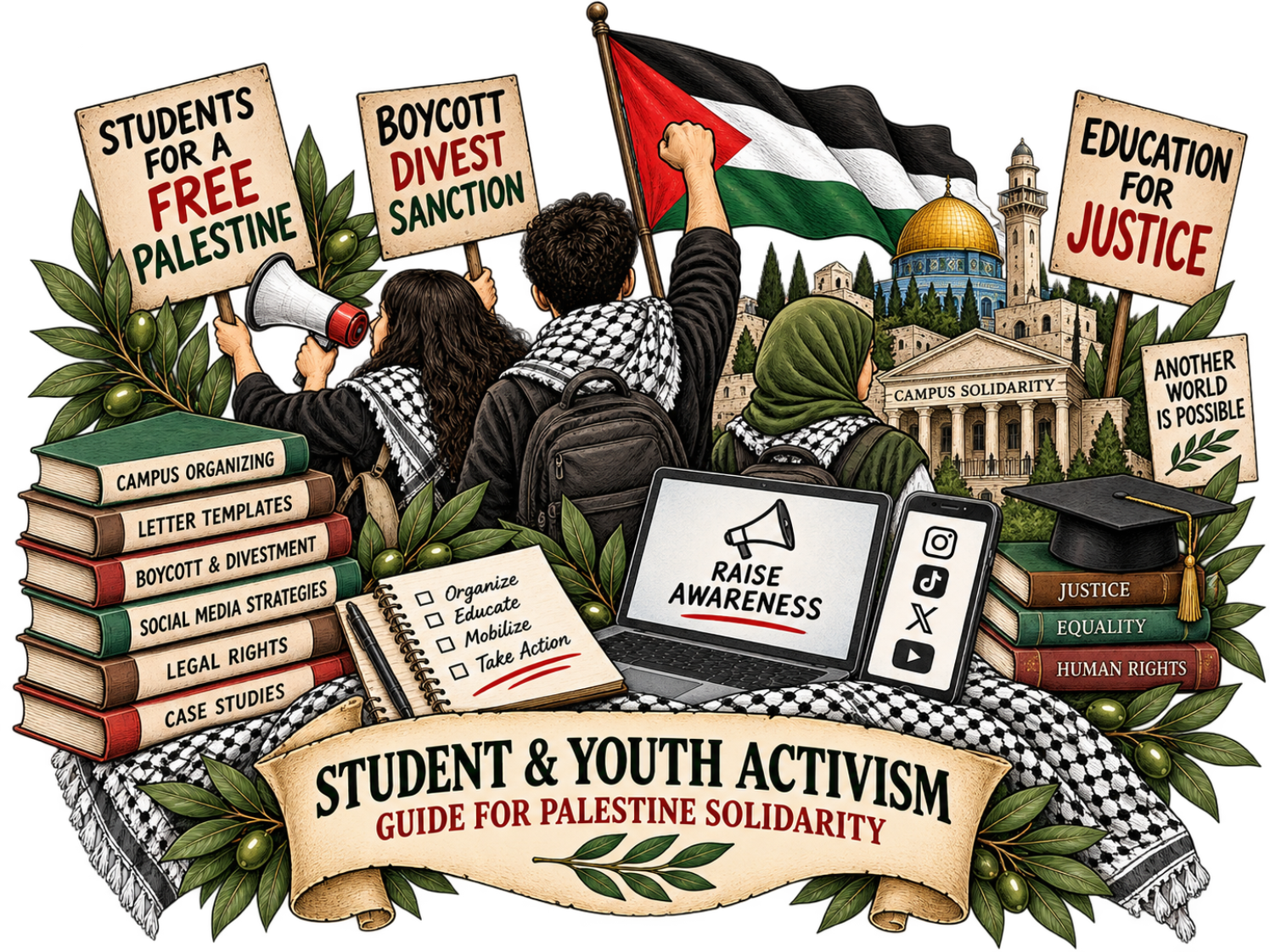
Student & Youth
Activism Guide for
Palestine Solidarity
From campus organizing to letter writing, from boycotts to social media campaigns — a comprehensive toolkit for students and youth to take effective action for Palestinian rights.
Campus Organizing Toolkit
How to start and sustain a Palestine solidarity group on campus — from the first meeting to building a movement.
View ToolkitLetter Templates & Advocacy
Ready-to-use letter templates to write to your elected officials demanding action on Gaza, settlements, and arms embargoes.
View TemplatesBoycott & Divestment Guides
How to implement BDS on campus and in your community — targeting companies complicit in occupation.
View GuidesSocial Media Campaign Strategies
How to use Instagram, TikTok, X, and other platforms to amplify Palestinian voices and counter misinformation.
View StrategiesLegal Rights for Protesters
Know your rights when protesting — what to do if detained, how to document police misconduct, and legal resources.
View Legal GuideCase Studies & Success Stories
How student movements won divestment victories, forced university policy changes, and built global solidarity.
View Success StoriesProtest & Demonstration Guide
Plan peaceful Palestine solidarity demonstrations with clear goals, logistics, safety planning, accessibility, documentation and lawful protest practices.
View Protest GuidePetition & Public Campaigns
Build focused public campaigns through petitions, open letters, public endorsements, community outreach and measurable campaign goals.
View Campaign GuideFundraising & Humanitarian Support
Support humanitarian relief responsibly through verified organizations, transparent fundraising and careful handling of donations and public appeals.
View Fundraising GuideCampus Divestment Toolkit
A practical guide to researching university investments, building student support, drafting divestment resolutions and engaging decision-makers.
View Divestment ToolkitMedia & Journalism Toolkit
Create responsible Palestine-focused media work through press releases, op-eds, journalist outreach, fact sheets, source verification and ethical storytelling.
View Media ToolkitResearch & Evidence Toolkit
Research Palestine-related issues using primary documents, credible reports, legal records, datasets and careful source verification.
View Research ToolkitDigital Security & Activist Safety
Protect activist accounts, communications, personal information and digital archives while reducing risks such as phishing, doxxing and account compromise.
View Safety GuideVerified Palestine Donations & Scam Awareness
How to verify Palestine and Gaza fundraisers, avoid fake NGOs and impersonation scams, and donate through official channels.
Donate SafelyCampus Organizing Toolkit
Starting a Palestine solidarity group on campus is one of the most effective ways to build sustained activism. This toolkit provides a step-by-step guide from the first meeting to a thriving movement.
Step 1: Found Your Group
- Find 3-5 like-minded students to form a core team
- Register with your student union (if required) to access meeting spaces and funding
- Create a clear mission statement: “We advocate for Palestinian human rights and an end to occupation”
- Set up communication channels: WhatsApp, Signal, Discord, or Telegram
- Create social media accounts (Instagram, TikTok, X) for the group
Step 2: Build Your Base
- Host an introductory event: film screening, speaker panel, or teach-in
- Partner with existing student groups (Muslim Students Association, Arab Students Association, social justice clubs)
- Recruit volunteers for specific roles: social media, events, outreach, research, art
- Collect email addresses and create a mailing list
- Build relationships with supportive faculty members
Step 3: Plan Your First Campaign
Choose a focused, achievable campaign to build momentum:
- Divestment resolution: Petition your university to divest from companies supporting occupation
- Boycott campaign: Target a specific company on campus (cafeteria contracts, vending machines, bookstore)
- Awareness week: Organize a “Palestine Week” with events, exhibitions, and workshops
- Scholarship for Gaza: Fundraise for Palestinian student scholarships
Step 4: Sustaining the Movement
- Hold regular meetings (weekly or biweekly) with clear agendas
- Rotate leadership roles to prevent burnout
- Document your activities (photos, videos, testimonials) for future campaigns
- Connect with national and international Palestine solidarity networks
- Celebrate wins, no matter how small — they keep morale high
Letter Templates & Advocacy
Writing to your elected representatives is one of the most direct forms of political advocacy. Below are templates you can adapt and send to your MP, congressperson, or parliamentary representative.
Urgent action on Gaza, civilian protection and government policy
Template 1: MP / Congressperson
Civilian protection, humanitarian access and UN action
Template 2: UN Secretary-General
Documenting violations, evidence and accountability
Template 3: UN Human Rights Bodies
Foreign policy, diplomatic pressure and arms policy
Template 4: Foreign Minister / Government
Divestment, partnerships, academic freedom and student safety
Template 5: University President / Chancellor
Local resolutions, humanitarian initiatives and public action
Template 6: Local Mayor / Council
Business relationships, supply chains and human-rights due diligence
Template 7: Company / Corporation
Accurate coverage, Palestinian voices and corrections
Template 8: Newspaper / Editor
Humanitarian solidarity, interfaith action and community support
Template 9: Religious Institution
Submitting a documented case with evidence and witness information
Template 10: Human Rights Organization
Boycott & Divestment Guides
BDS (Boycott, Divestment, Sanctions) is the most effective non-violent pressure tool used by the Palestinian civil society. Here’s how to implement it on campus and in your community.
Consumer Boycott Targets
Priority companies targeted by BDS:
- HP — Biometric ID systems for occupation
- Puma — Sponsors Israeli teams in settlements
- SodaStream — Historical ties to settlement factory
- McDonald’s — Israeli franchise donated free meals to IDF
- Starbucks — Sued union for pro-Palestine tweet
- Elbit Systems — Drones and surveillance tech
- Caterpillar — D9 bulldozers for demolitions
Campus Divestment Campaign Steps
- Research: Find out which companies your university invests in (check endowment reports)
- Petition: Gather student signatures demanding divestment
- Student Government Resolution: Introduce a divestment resolution
- Faculty Support: Get professors to sign an open letter
- Public Pressure: Organize rallies, sit-ins, and media coverage
- Alumni Network: Engage alumni to threaten donation withdrawal
Success Metrics
Social Media Campaign Strategies
Social media can help Palestinian voices reach large audiences, but effective advocacy requires accuracy, consent, context and responsible handling of sensitive material. The goal is not simply to post more. It is to publish information that people can understand, verify and act on.
1. Define the Campaign Goal
Start with one clear objective. A campaign asking people to contact representatives should not use the same message structure as a campaign promoting a historical explainer or a humanitarian appeal.
- Choose one primary action: Learn, sign, contact, attend, donate through a verified organization, share verified information or support a specific campaign.
- Define the audience: Students, local residents, journalists, policymakers, educators or a general public audience may require different language and context.
- Set a measurable outcome: For example, a target number of petition signatures, event attendees or representative contacts.
- Keep the message consistent: Use the same core facts and demand across platforms while adapting the format.
2. Build Content Around Evidence
- Lead with the key fact: Put the most important verified information near the beginning.
- Provide the source: Link to the original UN document, court record, report, dataset, official statement or reputable investigation whenever possible.
- Separate fact from allegation: Clearly distinguish a documented event, an allegation under investigation, a legal finding and your own analysis.
- Add dates and context: A statistic or quotation can be misleading when the date, location or surrounding circumstances are removed.
- Correct errors: If your campaign publishes something inaccurate, correct it clearly rather than silently replacing it.
3. Instagram Strategy
Use visual formats for explainers, timelines, quotations, maps and short educational sequences. Keep each slide focused on one idea and make the source visible rather than placing all sourcing in an inaccessible caption.
- Create carousels that move from claim → evidence → context → source → action.
- Use Reels for short explainers, interviews and campaign updates rather than relying only on emotional footage.
- Use Stories for event reminders, verified updates and links to primary sources.
- Use descriptive alt text and readable typography for accessibility.
4. TikTok Strategy
Short-form video works best when the first few seconds clearly establish the topic. Educational content should still provide enough context for viewers who know little about Palestine.
- Open with a specific question or factual point.
- Use on-screen text for names, dates and key terms.
- Do not present old footage as current footage.
- When discussing a disputed or developing claim, say what is known, what is alleged and what remains unverified.
5. X / Twitter Strategy
- Live threads: Explain events chronologically and link to primary sources.
- Source-first posts: Quote only the amount needed and direct readers to the full document.
- Journalist amplification: Share verified reporting and Palestinian journalists without removing their original context.
- Corrections: If a claim changes, update the thread and clearly mark the correction.
- Hashtags: Use relevant hashtags sparingly so the post remains understandable without them.
6. YouTube Strategy
Long-form video is useful for interviews, documentaries, lectures and evidence-based explainers. Give viewers a clear description, dates, sources and chapter structure.
- Use a strong title without exaggerating what the video proves.
- Put major sources in the description.
- Identify archival footage and its date where known.
- Do not crop interviews or quotations in a way that changes their meaning.
7. Telegram & WhatsApp
Private and semi-private channels can spread information quickly, which makes source verification especially important.
- Do not forward an unverified claim simply because it came from a trusted contact.
- Keep a link to the original source when forwarding important information.
- Do not share private phone numbers, addresses or identifying information without permission.
- Use separate channels or folders for verified source material and unverified leads.
8. Personal Stories & Palestinian Voices
- Ask permission: Obtain consent before publishing identifiable personal stories, photographs or recordings.
- Protect vulnerable people: Consider whether publishing a name, location or image could create additional risk.
- Preserve dignity: Avoid turning suffering into spectacle or using graphic material merely to increase engagement.
- Do not fabricate: Never invent quotations, captions, identities or circumstances to make a story stronger.
9. Countering Misinformation
Correct misinformation with evidence rather than simply repeating the false claim. Show the source, explain the verification process and state what remains uncertain.
- Check the date and original uploader of images and videos.
- Reverse-search or otherwise verify visual material when practical.
- Compare important claims with multiple credible sources.
- Check whether a statistic refers to Gaza, the West Bank, Israel, a specific period or a cumulative period.
- Do not treat a screenshot as proof of its own authenticity.
10. Archiving Your Campaign
- Save important posts, source documents and campaign graphics in an organized archive.
- Record the original URL and publication date.
- Keep copies of primary documents rather than relying on a social-media post as the only record.
- Where lawful and appropriate, preserve screenshots or web archives when material may later disappear.
11. Publishing Checklist
- Is the claim accurate and current?
- Do I have the original source?
- Have I provided enough context?
- Have I separated fact from allegation and opinion?
- Do images and videos actually match the date and event described?
- Do I have consent for identifiable personal material?
- Could this post expose someone to unnecessary risk?
- Is the requested action clear?
Legal Rights for Protesters
Protesting for Palestine can be an important form of peaceful civic participation, but laws and police powers differ substantially between countries, states, cities and campuses. This guide provides general preparation principles. It is not a substitute for advice from a qualified lawyer in your jurisdiction.
Your Basic Rights
- Right to peaceful assembly: In many jurisdictions, people have legal protections for peaceful gatherings, subject to lawful time, place and manner rules.
- Freedom of expression: Political criticism and advocacy are protected in many legal systems, but the exact limits vary by jurisdiction.
- Right to record: Rules on filming police and other people differ by location. Check local law and avoid interfering with official duties.
- Right to remain silent: Where local law provides this protection, you may have a right not to answer investigative questions beyond information you are legally required to provide.
- Right to legal counsel: If you are arrested or formally detained, ask how to contact a lawyer and use any available legal-support service.
Before You Attend a Protest
- Learn the local rules: Check whether the event requires a permit, whether there are restrictions on location or amplified sound, and whether there are special campus rules.
- Know the organizer: Read the event information, identify the organizers and understand the planned route, meeting point and end point.
- Save emergency contacts: Keep the organizer’s emergency number, a trusted contact and relevant legal-support numbers available offline.
- Tell someone your plan: Let a trusted person know where you are going and when you expect to return.
- Plan accessibility: Consider mobility, medication, rest, water, hearing needs and other requirements before attending.
- Protect personal information: Avoid carrying unnecessary sensitive documents or exposing private information in public posts.
What to Bring
- Identification: Carry identification if local law or your circumstances make it advisable, and understand the rules governing identification checks.
- Phone and power: Charge your phone and consider carrying a power bank.
- Water and essentials: Bring water, appropriate clothing and any essential personal items allowed at the event.
- Legal information: Save important numbers and legal guidance on your phone and, where practical, on paper.
- Accessibility supplies: Bring any items you personally need for mobility, communication or health.
During the Demonstration
- Stay peaceful: Follow the event’s stated safety rules and do not engage in violence or property damage.
- Follow lawful instructions: If authorities issue an instruction, do not physically resist. If you believe an instruction is unlawful, note the circumstances and seek legal advice later.
- Stay with your group: Use a buddy system and agree on a meeting point if people become separated.
- Keep emergency routes clear: Do not block ambulances, fire exits or other emergency access.
- Watch for changing conditions: Weather, crowd movement, road closures and police activity can change quickly.
If Police Stop or Question You
The exact rules depend on jurisdiction. Remain calm, avoid physical confrontation and ask clear questions about your status.
- Ask what is happening: Where lawful, ask whether you are being detained or are free to leave.
- Do not argue physically: Do not pull away, push or physically resist an officer.
- Do not guess: If you do not know an answer, do not invent one. Ask whether you are legally required to provide the information.
- Ask for legal help: If detained or arrested, request a lawyer where that right applies.
- Remember details: If safe and lawful, note the time, location, agency and other identifying details relevant to the encounter.
If You Are Arrested or Detained
- Stay calm: Avoid escalating the situation or physically resisting.
- Request legal assistance: Ask how to contact a lawyer or legal-support organization.
- Do not sign documents you do not understand: Ask for legal advice where available before signing anything beyond what the law requires.
- Ask about medical needs: Report injuries or urgent medical needs and request appropriate care.
- Preserve information: After release, write down what happened while your memory is fresh and preserve relevant documents or notices.
Documenting Police Conduct
Documentation can help preserve an accurate record, but safety and local law come first.
- Record safely: Do not place yourself or another person in danger merely to obtain footage.
- Know local recording rules: Laws concerning audio, photography, public filming and police recording vary.
- Preserve originals: Keep the original file and record when and where it was captured.
- Do not alter evidence: If you create an edited version for social media, keep the original separately.
- Protect bystanders: Avoid unnecessarily publishing identifiable images of vulnerable people.
Privacy, Doxxing & Online Safety
- Do not publish private information: Avoid posting home addresses, private phone numbers, identification documents or other sensitive details.
- Protect vulnerable participants: Ask before publishing identifiable photos or stories when consent is practical and appropriate.
- Secure your accounts: Use strong unique passwords and multi-factor authentication.
- Separate public advocacy from private information: A public campaign does not require exposing someone’s personal life.
Legal Support & Incident Records
- Keep an incident log: Record date, time, location, what happened, witnesses and available evidence.
- Preserve official documents: Keep citations, notices, arrest paperwork and court documents.
- Seek qualified advice: Contact a lawyer or established legal-support organization if you need advice about a specific incident.
- Report serious misconduct: Where appropriate, use the relevant complaint, oversight or legal process in your jurisdiction.
Accessibility & Participant Welfare
- Plan accessible meeting points and routes where possible.
- Provide clear information about toilets, water, rest areas and transport.
- Use a buddy system for participants who may need assistance.
- Have a plan for medical emergencies and know the location of nearby emergency services.
- Do not pressure participants to remain in a situation that feels unsafe.
After the Protest
- Check on your group: Confirm that participants have reached safe transport or home.
- Preserve evidence: Collect relevant photos, videos, statements and official documents in an organized archive.
- Correct the record: If your campaign published inaccurate information, issue a clear correction.
- Document outcomes: Record attendance estimates carefully, organizer actions, official responses and next steps without exaggeration.
- Review the event: Identify what worked, what created risk and what should change for future actions.
Case Studies & Success Stories
Student and youth activism has achieved concrete victories for Palestinian rights. These case studies demonstrate what’s possible with sustained, organized pressure.
Success Story 1: Columbia University Encampment (2024)
In April 2024, students at Columbia University set up a “Gaza Solidarity Encampment” on campus, demanding divestment from companies supporting Israel. The movement spread to 100+ campuses across the US and worldwide.
- Over 3,000 students arrested across US campuses
- Multiple universities agreed to review investments
- Inspired similar encampments in UK, Canada, Australia, and Europe
- Put unprecedented pressure on university administrations
Success Story 2: SOAS Divestment (2015-2018)
The School of Oriental and African Studies (SOAS) in London became one of the first UK universities to divest from companies involved in the occupation after a multi-year student campaign.
Success Story 3: Ben & Jerry’s Decision (2021)
After years of pressure from student groups and activists, Ben & Jerry’s announced it would stop selling ice cream in “Occupied Palestinian Territory” — a historic corporate acknowledgment of the illegality of settlements.
Key Lessons from Success Stories
- Persistence: Campaigns take years, not weeks
- Coalition building: Partner with diverse groups (faith, labor, human rights)
- Media savvy: Use social media and traditional press
- Legal awareness: Know your rights and push back against repression
- International solidarity: Connect with global movements
Protest & Demonstration Guide
Before You Plan
Start with a clear, lawful and achievable objective. Decide whether the demonstration is meant to raise public awareness, demand a policy change, support a humanitarian cause, or respond to a specific event. Write the main demand in one sentence so organizers, speakers and participants communicate the same message.
Choose the Format and Location
Decide whether a march, static rally, vigil, teach-in, public meeting or campus demonstration best fits the objective. Check local rules, venue restrictions, traffic requirements and accessibility before announcing the event. Choose a location that is visible but does not block emergency routes, hospitals, fire access or essential services.
Legal and Administrative Preparation
Rules differ by country, city, campus and venue. Check whether advance notice, a permit, insurance, amplified-sound permission or other authorization is required. Keep copies of relevant approvals and contact details for the responsible authority. Do not assume that rules from another city or country apply to your event.
Build the Organizing Team
Assign clear roles before the event: lead coordinator, route or venue coordinator, accessibility lead, welfare or first-aid contact, legal-support contact, media contact, photographer or documentation lead, volunteer coordinator and communications lead. Make sure every role has a backup person.
Set Ground Rules
Create a short code of conduct covering peaceful participation, non-discrimination, accessibility, respect for participants and bystanders, and de-escalation. Tell volunteers how to respond to harassment, arguments, medical emergencies and attempts to provoke confrontation. The goal is a safe demonstration, not escalation.
Messaging and Signage
Keep slogans, banners and speeches clear and factual. Avoid unverified statistics or claims that could undermine the campaign. Where a number, quote or legal claim is important, keep the source available. Use large, readable signs and avoid language that targets people because of religion, ethnicity or nationality.
Accessibility Planning
Plan for wheelchair access, seating where needed, accessible routes, hearing or visual needs, and a quiet or lower-stimulation area if practical. Use microphones that can be heard without creating unnecessary disturbance. Share accessibility information before the event so participants can decide whether the location works for them.
Participant Communication
Before the event, publish the meeting point, start time, expected duration, route if applicable, accessibility information, weather guidance, emergency contact and basic legal information. Tell participants not to share another person’s private information or identifiable images without appropriate consent.
Safety and Welfare
Use a buddy system so participants can check on one another. Encourage people to bring water, appropriate clothing and any necessary medication. Identify a visible first-aid point or responsible first-aid contact. Keep emergency routes clear and know the address or landmark to give emergency services.
Working With Police or Authorities
Stay calm and communicate clearly. Follow lawful directions concerning safety and access while documenting concerns through appropriate channels. If someone is detained, avoid physical confrontation. Note the time, location and relevant details if it is safe to do so, and use qualified legal support where available.
De-escalation
If a confrontation develops, create distance, move participants away from the immediate dispute and ask trained marshals or designated organizers to intervene. Do not encourage participants to retaliate. Avoid physical contact unless necessary to protect someone from immediate harm, and prioritize leaving a dangerous situation safely.
Documentation and Privacy
Record events accurately, especially serious incidents. Preserve original files, timestamps and links where possible. Blur or avoid publishing identifiable images of children, vulnerable people, bystanders or people who may face retaliation unless there is an appropriate reason and consent. Never publish private addresses, phone numbers or other sensitive personal information.
Media and Livestreaming
Designate one media contact so journalists know whom to approach. If livestreaming, explain what is being recorded and avoid broadcasting private details or the faces of vulnerable participants without consent. Keep a separate archive of original footage and note the date, location and photographer or source.
After the Demonstration
Hold a short debrief. Record attendance estimates carefully and label them as estimates unless independently verified. Collect incident reports, preserve evidence, thank volunteers and identify what should change next time. Publish a factual summary with sources rather than exaggerating turnout or outcomes.
If Something Goes Wrong
For serious injury or immediate danger, contact local emergency services. For suspected unlawful conduct, preserve relevant evidence and seek qualified legal advice. If you believe police misconduct occurred, record the details safely and use the appropriate complaint or oversight mechanism in your jurisdiction. Do not retaliate or attempt to punish individuals yourself.
Practical Organizer Checklist
Before announcing: objective, date, location, permissions, accessibility, route or venue plan, volunteer roles, emergency contacts, legal support, first-aid plan, media contact and participant guidance. On the day: briefing, buddy system, clear signage, emergency access, responsible documentation and de-escalation. Afterward: evidence backup, incident log, debrief and public report.
Petition & Public Campaigns
A petition is most effective when it connects a clearly defined problem to a decision-maker who has the authority to act. A strong public campaign does more than collect signatures. It builds a documented case, gives supporters practical ways to participate, creates public visibility and follows the decision-maker’s response.
1. Define the Campaign Objective
Start by writing the outcome you want in one sentence. Avoid broad demands that no single decision-maker can realistically implement.
- Choose one primary decision: Identify the policy, contract, investment, public statement, humanitarian measure or other action you want changed.
- Make the demand measurable: A decision-maker should understand exactly what you are asking them to do.
- Set a reasonable timeline: Decide when the petition will be delivered and when you expect a response.
- Identify the responsible authority: Confirm who actually has the power to accept, reject or implement the demand.
2. Build the Evidence Base
Explain why the demand is necessary using reliable and traceable information. A petition becomes more credible when supporters can check the underlying evidence themselves.
- Use primary documents, official records, court documents, UN material and credible research where available.
- Record the publication date and original source for important statistics and claims.
- Separate documented facts from allegations, interpretation and campaign opinion.
- Avoid outdated statistics when newer verified information is available.
- Link to the original source rather than relying only on screenshots or reposts.
3. Write a Strong Petition
The opening should quickly explain the issue, the requested action and why the recipient has responsibility for it.
- Headline: State the action you want in clear language.
- Context: Give a short evidence-based explanation of the problem.
- Demand: State the requested action precisely.
- Reason: Explain why the action matters and connect it to documented evidence or the institution’s own policies.
- Call to action: Tell supporters exactly what they are signing and what will happen to the petition.
4. Choose the Right Petition Platform
Use a platform that clearly explains how signatures are collected, stored and delivered. If your campaign concerns a university, council or organization, also check whether that institution has its own formal petition process.
- Read the platform’s privacy and data policies before collecting signatures.
- Check whether signatures or supporter names are publicly visible.
- Do not collect more personal information than the campaign needs.
- Keep a secure record of the final petition and delivery date.
5. Protect Supporters’ Privacy
- Explain collection: Tell supporters what information is collected and why.
- Minimize data: Do not publish phone numbers, addresses or sensitive information unnecessarily.
- Protect vulnerable people: Be especially careful with minors and people who could face academic, professional or personal consequences.
- Secure access: Use strong account practices and limit access to supporter data.
6. Build a Campaign Team
A petition campaign works better when responsibilities are divided rather than left to one person.
- Research: Verify claims and maintain the source file.
- Writing: Keep the petition concise and consistent.
- Outreach: Contact student, community, faith, labor and civil-society groups where appropriate.
- Design: Prepare accessible graphics and campaign materials.
- Media: Handle press enquiries and provide a fact sheet.
- Data/privacy: Manage supporter information responsibly.
- Delivery: Arrange the formal submission and document the response.
7. Grow the Petition Responsibly
Use several channels rather than depending on one viral post.
- Explain the issue before asking people to sign.
- Give supporters a ready-to-share message linking to the original petition.
- Ask partner organizations to explain their support in their own words.
- Use campus events, community meetings, teach-ins and peaceful public outreach where appropriate.
- Do not purchase fake signatures, fabricate endorsements or misrepresent supporter numbers.
8. Combine the Petition With Other Advocacy
Signatures are one tool, not the entire campaign. Combine them with actions that give the decision-maker a clear reason to respond.
- Send coordinated letters from constituents, students or community members.
- Request meetings with the responsible official or institution.
- Organize peaceful demonstrations or public meetings where lawful.
- Publish a concise evidence-based briefing for journalists and decision-makers.
- Use social media to explain the demand and document campaign milestones.
9. Deliver the Petition Strategically
- Confirm the correct office, email address or submission system.
- State the final verified signature count and collection period.
- Include a short briefing explaining the demand and supporting evidence.
- Request a written response or meeting where appropriate.
- Record the date, recipient and method of delivery.
10. Follow Up
- Set a follow-up date before the petition is delivered.
- If there is no response, send a concise reminder and repeat the specific demand.
- If the recipient responds, publish the response accurately and preserve the original communication.
- Distinguish an acknowledgement, promise to review, formal decision and implemented policy change.
- Tell supporters what happened next rather than declaring success solely because the petition received attention.
11. Measure the Campaign
Track more than signature totals. Useful indicators include the quality of the response, meetings obtained, policy changes, public commitments, media coverage and concrete implementation.
- Verified signature count
- Supporting organizations or groups
- Meetings or formal submissions obtained
- Public or written response
- Policy, procurement, investment or humanitarian changes
- Actions actually implemented
12. Archive the Campaign
Keep the petition text, final signature count, source file, campaign graphics, delivery record, responses and documented outcomes together. This creates a reliable record for future organizers.
Fundraising & Humanitarian Support
Fundraising can support humanitarian relief, but it should be transparent and directed through legitimate channels. Never pressure people to donate to an unverified individual or payment account.
Responsible Fundraising
- Use official donation pages of verified humanitarian organizations whenever possible.
- Explain exactly what funds are intended to support.
- Keep fundraising records and communicate updates honestly.
- Do not use copied logos, misleading claims or fabricated emergencies.
- Never publish a donor’s personal information without permission.
Campus Divestment Toolkit
Campus divestment campaigns ask universities to review investments, end or restrict relationships that conflict with institutional policies or stated human-rights commitments, and create transparent procedures for responsible investment. A strong campaign combines research, coalition building, a precise proposal and sustained engagement with the university’s actual decision-making process.
1. Understand How Your University Makes Decisions
Before demanding divestment, identify who has authority over the relevant decision. Depending on the institution, investments may be controlled by a board, trustees, investment committee, endowment office, finance office or another governing body.
- Find the university’s investment, endowment and procurement policies.
- Identify the board, committee or administrator responsible for the relevant decision.
- Check whether students can introduce resolutions through student government.
- Learn the rules for petitions, referendums, hearings, public comments and campus demonstrations.
- Find out whether the university publishes an endowment report or responsible-investment policy.
2. Research the University’s Financial Connections
Build the campaign on documented information rather than assumptions. The objective is to identify a specific relationship and explain why campaigners are asking the university to review or end it.
- Review publicly available endowment and investment disclosures.
- Check procurement contracts and publicly documented institutional partnerships where available.
- Identify the company, fund, financial instrument or relationship precisely.
- Record the source, publication date and relevant page or document section for every important claim.
- Use multiple reliable sources when a relationship is complex or indirect.
3. Build a Research File
Create one central document so every organizer is working from the same evidence.
- Company or fund name
- University connection
- Documented activity or relationship
- Source links and dates
- University policy or commitment potentially involved
- Specific action requested
- Questions that remain unanswered
4. Build a Broad Coalition
Successful campaigns often involve more than one student group. Work respectfully with students, faculty, staff, alumni, community organizations and other campus constituencies where appropriate.
- Invite groups with different perspectives to agree on a clear minimum demand.
- Assign practical roles such as research, outreach, design, media, accessibility and meeting coordination.
- Create a shared calendar and communication system.
- Make meetings accessible to students with different schedules and needs.
- Keep internal records so campaign knowledge is not lost when students graduate.
5. Write a Specific Divestment Resolution
A strong resolution should tell the decision-maker exactly what action is requested and how the university can implement it.
- Background: Explain the issue using documented sources.
- Policy basis: Connect the proposal to the university’s own stated investment, ethics or human-rights commitments.
- Scope: Define which investments, companies, funds or relationships are covered.
- Action: State whether the request is divestment, review, exclusion, disclosure, procurement change or another specific measure.
- Timeline: Ask when the university should report progress.
- Transparency: Request public reporting where appropriate and lawful.
6. Work Through the Formal Process
- Submit the resolution through the correct student-government or university process.
- Request meetings with the responsible administrators or trustees.
- Prepare a short evidence pack for decision-makers.
- Bring students and faculty who can explain why the issue matters to the university community.
- Record the university’s response accurately and preserve written communications.
7. Use Public Pressure Responsibly
Public campaigning can include petitions, teach-ins, peaceful demonstrations, open letters, media work and meetings. Keep the campaign focused on the institution and the documented policy question.
- Publish the exact demand so supporters and decision-makers know what success means.
- Use verified evidence rather than rumors about individuals.
- Protect student privacy and avoid publishing personal information unnecessarily.
- Follow campus rules while also documenting any relevant restrictions or disputes.
- Keep public messaging consistent across flyers, social media and press materials.
8. Respond to Common University Objections
- “The university has no direct control.” Ask what information, review mechanisms or investment policies are available and who actually has authority.
- “The request is too broad.” Narrow the proposal to clearly defined companies, funds, contracts or policy criteria.
- “We need more evidence.” Provide a documented evidence pack with primary sources and explain what remains uncertain.
- “This will harm the university financially.” Ask for the relevant policy, investment analysis or evidence supporting that claim.
- “Students do not decide investments.” Use the formal governance process to identify where student input can be considered.
9. Track the Campaign
Keep a public timeline of major milestones. This makes the campaign easier to understand and prevents claims of success or failure from becoming vague.
- Record when the campaign began.
- Record petitions, votes, meetings and formal submissions.
- Record the university’s written responses.
- Document any policy changes or commitments precisely.
- Update supporters when evidence or university policy changes.
10. Measure the Outcome
Not every campaign ends with immediate divestment. Outcomes can include a formal review, new disclosure requirements, procurement changes, an investment-policy amendment, a committee process or a completed divestment decision.
- Define the original demand.
- Identify what the university actually changed.
- Distinguish a promise, review, vote and completed policy change.
- Keep documentary evidence for every claimed outcome.
Media & Journalism Toolkit
Start With the Evidence
Good Palestine-focused advocacy depends on accurate, well-sourced communication. Before publishing, identify exactly what you are claiming, what evidence supports it, and what remains uncertain. Keep the original source, publication date and link with your working notes.
Verify Before You Publish
For important claims, prefer primary sources such as official documents, court records, UN material, original footage, direct statements and named research. Cross-check significant claims with more than one reliable source when possible. Be especially careful with casualty figures, quotations, locations, dates and claims about responsibility.
Separate Fact, Claim and Analysis
Use clear wording. A documented event can be described as documented. An allegation should be identified as an allegation. An investigation should not be presented as a final finding. Your own interpretation should be distinguishable from the underlying evidence.
Press Release Structure
A useful press release should contain a short headline, one-sentence summary, key verified facts, why the issue matters, a quote from an authorized spokesperson, relevant background, source links and media contact information. Keep the most important information near the top.
Writing an Op-Ed
Build one central argument rather than trying to cover every issue. Open with a strong but factual point, explain the evidence, address the strongest reasonable counterargument, and end with a specific action or policy request. Cite primary sources for major factual claims.
Build a Fact Sheet
Create a one- or two-page document with the issue, key dates, verified statistics, definitions, a short chronology, primary-source links and contact details. Add the date of publication and a version number so readers can tell when it was last updated.
Pitching Journalists
Research the journalist’s beat before contacting them. Explain why the story is timely, provide two or three verified facts, identify available sources or experts and state what is new. Do not send mass pitches that ignore the journalist’s area of coverage.
Center Palestinian Voices
When reporting personal experiences, prioritize consent, dignity and safety. Explain how a person’s words, image or testimony will be used. Do not pressure people to relive traumatic experiences for content. Where possible, let people describe their own experiences in their own words.
Interview and Quote Carefully
Record or take accurate notes with permission. Preserve the full context of quotations. Do not edit a quote in a way that changes its meaning. Confirm names, spellings, roles and dates before publication, especially when errors could put someone at risk.
Correcting Misinformation
When a false or misleading claim circulates, identify the exact claim, provide the strongest available evidence, explain what the evidence establishes and link to the source. Avoid repeating sensational falsehoods more than necessary. If your own material was wrong, correct it visibly and explain what changed.
Images, Video and Verification
Check when and where visual material was created before using it as evidence. Look for original uploads, metadata where available, landmarks, weather, shadows, language and independent reporting. Reverse-image searches and frame-by-frame review can help identify recycled or miscaptioned material.
Social Media Publishing
Use concise posts that link back to evidence. Put dates and locations on graphics when relevant. Avoid presenting old footage as current. Keep a record of source links because posts and accounts can disappear. Do not expose private information simply to increase engagement.
Archiving Your Work
Maintain an organized archive containing original files, screenshots, source URLs, publication dates, notes about verification and versions of your own posts. Where lawful and appropriate, keep redundant backups. For sensitive material, restrict access and avoid unnecessary personal data.
Editorial Checklist
Before publishing, ask: What exactly am I claiming? What is the primary source? Is the date correct? Is the location verified? Have I separated allegation from finding? Have I given Palestinian voices appropriate space? Do I have consent? Could this publication expose someone to avoidable harm? Can a reader independently check my sources?
Research & Evidence Toolkit
Research becomes stronger when every important claim can be traced to a source and readers can distinguish documented facts from allegations, investigations, legal findings and interpretation. This toolkit is designed for Palestine-related research, advocacy, journalism and educational work.
1. Start With the Primary Source
Whenever possible, locate the document behind a claim instead of relying on a social-media summary or secondary article.
- UN material: Resolutions, reports, statements, commissions of inquiry and humanitarian updates.
- International courts: Judgments, orders, filings and official case records where publicly available.
- Government records: Legislation, official statements, parliamentary records and published data.
- Original institutional records: Company filings, university documents, NGO reports and archived publications.
- Academic research: Peer-reviewed studies, books and research-center publications.
2. Build a Source Hierarchy
Not every source answers the same question. Match the source to the claim you are trying to establish.
- Tier 1: Primary documents, courts, UN bodies, official records and original datasets.
- Tier 2: Established human-rights and humanitarian organizations with transparent methodology.
- Tier 3: Academic books, peer-reviewed research and reputable investigative journalism.
- Tier 4: Secondary databases and reference material used as supporting evidence and checked against stronger sources.
3. Verify the Exact Claim
Do not assume that a source proves more than it actually says. Read the relevant passage, footnote, methodology and date.
- Write down the exact claim you are testing.
- Locate the passage, table or data point supporting it.
- Check who produced the source and for what purpose.
- Check whether it reports a fact, allegation, estimate, finding or opinion.
- Check the geographic and time period covered.
- Record important qualifications and limitations.
4. Cross-Check Important Claims
For consequential claims, compare independent credible sources. Agreement can strengthen confidence, while disagreement should be documented rather than hidden.
- Compare the original source with an independent credible source when practical.
- Check whether two articles are actually repeating the same original report.
- When sources disagree, identify whether the difference concerns date, definition, methodology, estimate or interpretation.
- Do not combine conflicting figures without understanding how each was produced.
5. Distinguish Fact, Allegation, Investigation and Legal Finding
- Documented event: Reliable evidence indicates that an event occurred.
- Allegation: A person or organization has made a claim that has not been established as fact.
- Investigation: A competent body is examining evidence or allegations.
- Legal finding: A competent legal body has reached a formal finding or order.
- Analysis: An informed interpretation that should be clearly identified as analysis.
6. Record Source Metadata
- Title of the document or page
- Authoring organization or author
- Publication date
- Original URL or document identifier
- Relevant page, paragraph, table or section
- Date accessed or downloaded
- Short note explaining which claim it supports
7. Research Numbers and Statistics Carefully
- Check the definition behind every number.
- Check whether figures are cumulative, daily, estimated or independently verified.
- Check the reporting period and geographic area.
- Do not mix incompatible datasets without explaining the difference.
- Preserve the original methodology behind statistical estimates.
- Use the newest reliable figure when current data is required, while preserving historical figures for historical analysis.
8. Verify Images, Videos and Social Posts
Visual material can be powerful evidence, but an authentic image can still be miscaptioned or from another time and place.
- Find the earliest credible source or original uploader.
- Check date and location.
- Compare landmarks, signs and other contextual clues when necessary.
- Look for independent reporting or official documentation.
- Do not treat a screenshot as proof of authenticity.
- Preserve the original URL and a copy where lawful and appropriate.
9. Research People and Organizations
- Confirm full names and roles from reliable sources.
- Distinguish current positions from former positions.
- Check official biographies, institutional records and reputable reporting.
- For organizations, record legal name, location, stated purpose and documented activities.
- Do not attribute statements or actions to an organization solely because someone online uses its name or logo.
10. Build an Evidence File
Create a structured evidence file rather than a loose collection of links.
- Claim: What are you trying to establish?
- Evidence: Which source supports it?
- Source quality: Why is the source appropriate?
- Date: When was the evidence produced?
- Status: Documented fact, allegation, investigation, finding or analysis?
- Contradictory evidence: Is there credible information pointing elsewhere?
- Conclusion: What can safely be said?
11. Preserve and Archive Sources
- Download important reports and primary documents where permitted.
- Use meaningful filenames and dates.
- Maintain backups of important research material.
- Record original URLs because web pages can change or disappear.
- Use reputable archiving methods where lawful and appropriate.
- Never alter an original document and present the altered copy as the source.
12. Research for Publication
Before publishing a major claim, perform a final source audit.
- Can every important factual statement be traced to a source?
- Does the source actually support the wording used?
- Are dates, names and numbers correct?
- Have legal conclusions been attributed to the relevant legal body?
- Have allegations been clearly identified?
- Have significant limitations or uncertainty been disclosed?
- Can another researcher reproduce the verification?
13. Avoid Common Research Errors
- Single-source dependence: Do not make one article the only evidence for a major claim.
- Outdated data: Check whether newer reliable data exists.
- Context collapse: Preserve dates, locations and qualifications.
- Source laundering: Trace secondary reporting back to the original document.
- False precision: Do not present an estimate as an exact figure.
- Viral material: Popularity is not evidence.
14. Create a Reproducible Research Trail
For serious archive work, another researcher should be able to follow your trail and understand how you reached a conclusion.
- Keep a dated research log.
- Save the original source and relevant page or passage reference.
- Record why each source was included.
- Record unresolved questions and contradictory evidence.
- Update the record when new evidence changes the picture.
Digital Security & Activist Safety
Activists can reduce avoidable digital risks by protecting accounts, communications, personal information and archives.
Essential Practices
- Use unique, strong passwords and a reputable password manager.
- Enable two-factor authentication.
- Keep devices, browsers and apps updated.
- Be cautious with unexpected links, attachments, login requests and impersonation messages.
- Review privacy settings and limit unnecessary personal information.
- Maintain secure backups of important documents, photos and research.
- If you face threats or doxxing, preserve evidence and seek appropriate local legal or safety support.
Verified Palestine Donations & Scam Awareness
Donate with care. Verify before you give. Palestine and Gaza-related fundraising can attract genuine humanitarian support, but scammers may also exploit urgency, copied logos, impersonation accounts, fake NGOs and unofficial payment links.
Before You Donate
- Start from the official website: Type the organization’s web address yourself or use a link from its verified official channels. Do not rely only on a forwarded post or a direct message.
- Check the domain carefully: Look for misspellings, unusual country domains, shortened links and websites that imitate a legitimate organization’s branding.
- Verify the exact organization: Check its legal name, official contact information, public reporting and the purpose of the appeal.
- Check where the money goes: Read the current appeal or project description and make sure the payment page belongs to the organization itself.
- Be cautious with personal payment requests: Personal bank accounts, cryptocurrency wallets, gift cards and urgent private payment requests require independent verification before you send money.
- Do not let urgency replace verification: A genuine emergency does not mean you should skip basic checks.
- Keep your records: Save the donation receipt, confirmation email and the official appeal page used for the donation.
Established Humanitarian Organizations
The following organizations are widely established humanitarian or medical organizations with official donation channels. Use their own current websites and verify the donation page each time you give.
United Nations Relief and Works Agency for Palestine Refugees in the Near East.
Official Gaza Donation Page
International medical humanitarian organization providing emergency medical assistance in crisis settings.
Official Donation Page
Palestinian humanitarian and emergency medical organization providing ambulance, health and relief services.
Official Website
Humanitarian and medical support organization focused on children in Palestine and other regions.
Official Website
UK-based medical humanitarian organization supporting Palestinian health and wellbeing.
Official Donation Page
Humanitarian organization providing relief and development assistance to Palestinians and other communities in the region.
Official Donation Page
International humanitarian organization with Palestine and Gaza-related emergency appeals.
Official Website
A Gaza-based food relief initiative. Verify its current official fundraising channel and identity before donating.
Official Website
How to Spot a Suspicious Fundraiser
- Impersonation: The account uses the name, logo or photographs of a real organization but the payment destination belongs to someone else.
- Pressure tactics: The fundraiser says you must pay immediately and discourages questions or independent verification.
- Unverifiable claims: It provides dramatic stories but no credible organization, registration information, transparent contact details or traceable reporting.
- Payment mismatch: The person asking for money says they represent an NGO but asks you to pay into an unrelated personal account or wallet.
- Copied material: Photos, videos, logos or text appear to be copied from legitimate organizations without a clear connection to the fundraiser.
- Suspicious links: The page redirects through unfamiliar domains or asks for unnecessary passwords, banking credentials or sensitive information.
If You Suspect a Scam
- Stop: Do not send additional money or provide more personal or financial information.
- Document: Save screenshots, usernames, URLs, payment instructions, receipts and relevant messages. Preserve the original evidence where possible.
- Contact your payment provider: If you already paid and suspect fraud, contact your bank, card provider or payment service promptly and ask what recovery or fraud-reporting options are available.
- Report locally: Report suspected fraud to the appropriate local police or cybercrime authority in your country.
- Report the platform account: Use the platform’s built-in reporting process for the account, page, advertisement or fundraiser.
- Warn responsibly: Share verified evidence so others can avoid the scam. Do not publicly accuse an individual or organization unless the evidence supports the claim.
Important Safety Rule
Gaza Diary does not collect donations or process payments for these organizations. A name appearing on this page does not make an unrelated fundraiser legitimate. Always use the organization’s current official website and verify the exact payment destination before donating.