Palestine FAQ, Palestine FAQ covering history, Zionism, occupation, Gaza war, refugees, resistance, international law, media and the Palestinian struggle.
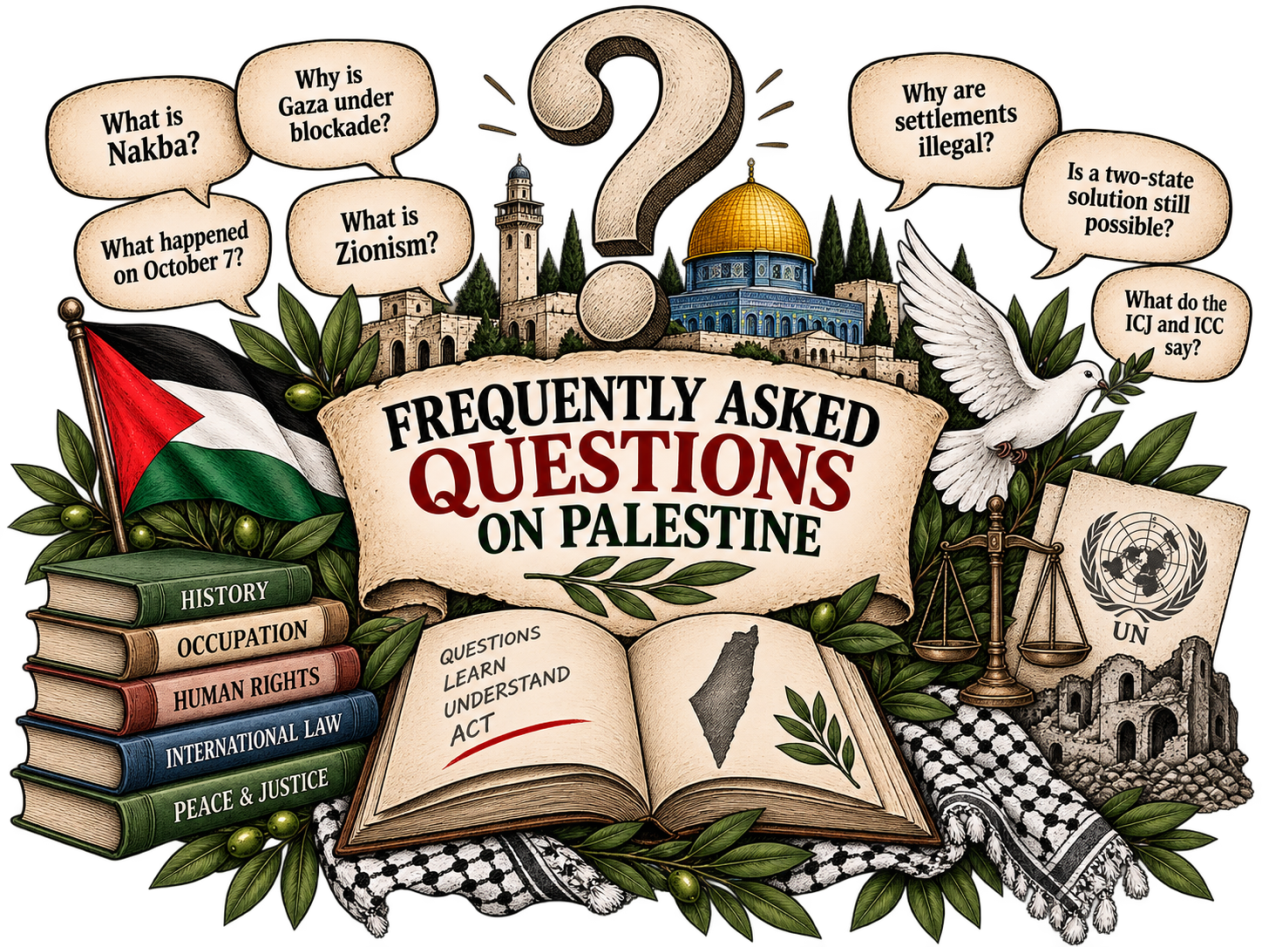
Frequently Asked
Questions on
Palestine
Clear, evidence-based answers to the most common questions about Palestine — from the history of the conflict to the current situation, from criticism of Israel to the path forward.
History & Background Questions
What is Nakba? What happened in 1948? Why did Palestinians leave their homes? The foundational history explained.
View AnswersZionism, Judaism & Antisemitism
Is criticism of Israel antisemitic? What is Zionism? How does Judaism relate to Zionism? Critical distinctions explained.
View AnswersOccupation, Settlements & Blockade
Why are settlements illegal? What is the Gaza blockade? Why is Gaza called an “open-air prison”? All explained.
View AnswersOctober 7 & The Gaza War
What happened on October 7? Is Israel committing genocide? Why did Hamas attack? Context and evidence.
View AnswersTwo-State Solution & Peace Process
Is the two-state solution still viable? Why do Palestinians reject it? What’s the alternative? Explained.
View AnswersInternational Law, ICJ, ICC & Accountability
What did the ICJ rule? What are the ICC arrest warrants? Can Israel be held accountable? Legal answers.
View AnswersPalestinians, Identity & Citizenship
Questions about Palestinian identity, citizenship, political status, Gaza, the West Bank and East Jerusalem.
View AnswersPalestinian Refugees & Right of Return
Nakba displacement, refugee status, UNRWA, the right of return and the unresolved Palestinian refugee question.
View AnswersHamas, Fatah, PLO & Palestinian Politics
Understand the major Palestinian political movements, the Palestinian Authority, Gaza governance and political divisions.
View AnswersGaza, Humanitarian Crisis & Reconstruction
Humanitarian access, displacement, food, water, healthcare, aid and the immense challenges of rebuilding Gaza.
View AnswersPalestinian Resistance & Nonviolent Struggle
The history of Palestinian resistance, Intifadas, civil resistance, BDS and the legal distinction between resistance and attacks on civilians.
View AnswersMedia, Propaganda & Information Warfare
How Palestine is represented in media, how misinformation spreads, and how to verify images, videos, claims and sources.
View AnswersHistory & Background Questions
Nakba means “Catastrophe” in Arabic. It refers to the events of 1947-1948 when over 750,000 Palestinians — more than half the population — were forcibly expelled from their homes by Zionist militias. Over 530 villages were completely destroyed, their names erased from maps.
Key facts:
- 70+ documented massacres (Deir Yassin, Tantura, Lydda, etc.)
- 78% of historic Palestine was seized by Israel
- 5.9 million refugees today (including descendants)
- UN Resolution 194 affirmed the right of return in 1948 — Israel has never implemented it
Important: The Nakba is not just a historical event — it is ongoing. Palestinians continue to be displaced through home demolitions, settlement expansion, and the Gaza war.
Israel’s official narrative claims Palestinians left voluntarily after Arab leaders told them to. This is a documented myth.
The reality:
- 2/3 fled in terror after massacres like Deir Yassin (107-254 killed in one village)
- 1/3 were directly expelled — like the 50,000+ marched out of Lydda and Ramle in the “Lydda Death March”
- BBC monitoring records found no evidence of Arab leaders calling for evacuation — in fact, they urged people to stay
- Israeli historian Ilan Pappe and Benny Morris have documented this extensively
No. This famous Zionist slogan is factually false. In 1947, Palestine had a population of approximately 1.3 million Arabs (Muslims and Christians) and about 600,000 Jews. Arabs constituted 67% of the population and owned 93-94% of the land.
Palestine had thriving cities (Jaffa, Haifa, Jerusalem), universities, newspapers, a rich cultural life, and a deeply rooted agricultural economy. The idea that it was “empty” was colonial propaganda designed to justify settlement.
The Balfour Declaration (2 November 1917) was a letter from British Foreign Secretary Arthur Balfour promising a “national home for the Jewish people” in Palestine. What made it so problematic:
- Britain did not control Palestine at the time — it was still Ottoman territory
- The promise was made without consulting the native population (92% Arab)
- Palestinians were referred to merely as “existing non-Jewish communities”
- They were promised only “civil and religious rights” — no political or national rights
- This colonial promise became the legal foundation for the Mandate and eventual Israeli statehood
Zionism, Judaism & Antisemitism
No. Criticism of Israeli government policies, the occupation, and human rights violations is not antisemitism — just as criticism of Saudi Arabia is not Islamophobia, or criticism of China is not anti-Asian racism.
This distinction is crucial:
- Antisemitism = hatred of Jews as Jews (religious/ethnic bigotry)
- Criticism of Israel = opposition to policies of a state/government (political dissent)
Many of the most prominent critics of Israel are Jewish themselves — including Israeli historians like Ilan Pappe and Avi Shlaim, organizations like Jewish Voice for Peace and IfNotNow, and Holocaust survivors like Hajo Meyer.
In fact, conflating Judaism with Zionism is itself antisemitic because it assumes all Jews support Israel and are responsible for its actions.
Zionism is a political ideology that emerged in the late 19th century advocating for the establishment of a Jewish state in Palestine. It is not a religious movement — many early Zionists were secular or even atheist.
Key points:
- Founded by Theodor Herzl in 1897 at the First Zionist Congress
- Based on the slogan “A land without a people for a people without a land” — which ignored the existing Arab population
- Not all Jews are Zionists — many Orthodox Jews (like Neturei Karta) oppose Zionism on religious grounds
- Not all Zionists are Jews — some Christian Zionists support Israel for theological reasons
- Zionism has evolved — from pre-1948 settlement to post-1967 settler colonialism
Important: Opposing Zionism as a political ideology is not antisemitism. It is opposition to a specific nationalist project that resulted in the displacement of Palestinians.
The Holocaust was a horrific genocide in which 6 million Jews were murdered by Nazi Germany. It is one of the darkest chapters in human history and must never be forgotten or minimized.
However:
- Palestinians bore no responsibility for the Holocaust — it happened in Europe
- Yet Palestinians were forced to pay the price — losing their homes and land to accommodate Jewish refugees
- Logic would suggest Europe should have provided a homeland, not displace an unrelated third party
- The Holocaust does not justify the ongoing occupation, settlements, and killing of Palestinians
- Many Holocaust survivors themselves opposed using their trauma to justify Palestinian dispossession
As Holocaust survivor Hajo Meyer said: “I am a survivor of Auschwitz. I am against the occupation. The occupation is a form of abuse.”
Occupation, Settlements & Blockade
Israeli settlements are illegal under international law for a clear reason:
Geneva Convention Article 49(6): “The Occupying Power shall not deport or transfer parts of its own civilian population into the territory it occupies.”
- 700,000+ Israeli settlers now live in the occupied West Bank and East Jerusalem
- UN Security Council Resolution 2334 (2016) called settlements a “flagrant violation of international law”
- The ICJ ruled in July 2024 that the entire occupation and settlement enterprise is illegal, and Israel must evacuate all settlements
- Israel has rejected these rulings and continues to expand settlements
The term was coined by David Cameron (former UK Prime Minister) and is used by human rights organizations because:
- 2.3 million people are trapped in 365 km² — one of the densest places on Earth
- Israel controls all borders, airspace, and sea access
- No one can leave without Israeli permission — which is rarely granted
- Imports and exports are strictly controlled by Israel
- Since 2007, the blockade has caused 65% poverty, 80% aid dependence
- 97% of groundwater is contaminated
- Electricity is available only 4-8 hours per day
Human Rights Watch states: “Israel’s closure policy amounts to collective punishment of the entire Gaza population.”
Yes, according to three landmark reports:
- B’Tselem (2021): “A regime of Jewish supremacy from the Jordan River to the Mediterranean Sea: This is apartheid.”
- Human Rights Watch (2021): “Israeli authorities have committed the crimes against humanity of apartheid and persecution.”
- Amnesty International (2022): “Israel’s cruel system of domination constitutes apartheid.”
Key features documented:
- Two legal systems: civil courts for Israelis, military courts for Palestinians
- Segregated roads, housing, and communities
- Unequal access to water, land, and movement
- Nation-State Law (2018) institutionalizes Jewish supremacy
October 7 & The Gaza War
On 7 October 2023, Hamas and other Palestinian armed groups launched a surprise attack on southern Israel from Gaza. The UN Independent International Commission of Inquiry reported that more than 1,200 people were killed, according to Israeli sources, and that 251 people were abducted and taken to Gaza as hostages.
Key context:
- The attack came after 16 years of blockade on Gaza and decades of occupation
- It was the deadliest single day for Jews since the Holocaust
- Hamas cited Israeli raids on Al-Aqsa Mosque, settlement expansion, and prisoner abuse as motivations
- The attack was a war crime — targeting civilians is prohibited under international law
- Human Rights Watch documented numerous atrocities committed during the attack
Important: Documenting October 7 does not justify Israel’s response — just as condemning Israel’s actions does not minimize October 7. Both can be recognized as violations of international law.
The International Court of Justice (ICJ) has found a “plausible” risk of genocide — the highest threshold for a preliminary ruling.
Evidence that led to this finding:
- 50,000+ Palestinians killed — 17,000+ children, 12,000+ women
- Israeli officials’ statements — Defense Minister Gallant: “We are fighting human animals”; President Herzog: “No innocent civilians in Gaza”
- Starvation as a weapon — ICC arrest warrants cite “starvation as a method of warfare”
- Destruction of infrastructure — 70%+ of buildings destroyed, all universities, 31 of 36 hospitals
- Mass displacement — 90% of population (1.9M people)
- ICJ orders ignored — Israel continued operations after court ordered halt
The final verdict may take years, but the preliminary rulings are unprecedented.
Hamas’s own stated reasons include:
- 16 years of blockade that has crippled Gaza’s economy and trapped 2.3 million people
- Al-Aqsa provocations — increasing Israeli incursions into the holy site
- Settlement expansion — 700,000+ settlers in the West Bank
- Prisoner issues — 9,000+ Palestinians in Israeli prisons, many without trial
- Normalization deals — Arab states signing agreements with Israel while ignoring Palestine
Key nuance: Explaining motives is not the same as justifying actions. Hamas’s targeting of civilians was a war crime. However, the attack did not occur in a vacuum — it emerged from decades of occupation and blockade.
Two-State Solution & Peace Process
Increasingly, no. The two-state solution — an independent Palestine alongside Israel based on 1967 borders — has been the framework for negotiations for decades, but:
- 700,000+ settlers now live in the West Bank — evacuation is politically impossible
- The West Bank is fragmented into 227+ disconnected enclaves
- East Jerusalem has been annexed; Israel claims it as its “complete and united capital”
- Gaza and the West Bank are separated by Israeli territory
- Successive Israeli governments have expanded settlements while negotiating
UN Secretary-General António Guterres: “The two-state solution is being strangled.”
Palestinian rejection of the two-state solution is not about denying Jewish rights — it’s about the terms being offered:
- Palestinians were asked to accept 22% of historic Palestine (they had 94% in 1947)
- No right of return for 5.9 million refugees
- No full sovereignty — Israel would retain security control
- No contiguity — the West Bank is fragmented into enclaves
- Settlements would remain or expand
As Edward Said said: “The two-state solution has become a one-and-a-half state solution.”
Given the collapse of the two-state paradigm, several alternatives are being discussed:
- One Democratic State: Equal rights for all citizens between the Jordan River and the Mediterranean Sea (advocated by Edward Said, Rashid Khalidi)
- Confederation: Two states with open borders, shared institutions (EU-like model)
- Status Quo: Current occupation continues — which human rights organizations call “apartheid”
The key principle: equal rights for all, regardless of ethnicity or religion. Whatever the political arrangement, it must end the system of Jewish supremacy over Palestinians.
International Law, ICJ, ICC & Accountability
On 19 July 2024, the International Court of Justice issued a historic advisory opinion ruling:
- Israel’s occupation is ILLEGAL — the first time the world’s highest court made this ruling
- Settlements must be evacuated — all 700,000+ settlers
- The wall must be dismantled
- Reparations must be paid to Palestinians
- All states have an obligation not to recognize or support the occupation
The vote was 11-4 (US among the dissenters). Israel rejected the ruling; the US called it “unhelpful.”
On 21 November 2024, the International Criminal Court issued arrest warrants for:
- Benjamin Netanyahu (Israeli PM) — War crimes including “starvation as a method of warfare”
- Yoav Gallant (former Defense Minister) — Same charges
- Mohammed Deif (Hamas military leader) — War crimes on October 7
What this means:
- 124 ICC member states must arrest them if they enter their territory
- Netanyahu and Gallant cannot travel to most European countries
- It is a historic precedent — first time a US ally’s leaders face ICC prosecution
- The US (not an ICC member) rejected the warrants
The legal architecture for accountability is now in place:
- ICJ rulings establish the legal illegality of the occupation
- ICC warrants create legal consequences for individuals
- Universal jurisdiction — several European countries have tried Israeli officials in absentia
- Apartheid findings by Amnesty, HRW, B’Tselem create reputational costs
However, enforcement depends on political will. The US has provided unconditional diplomatic shield — vetoing 50+ UN resolutions. Real accountability requires changing that political calculus.
History shows that change is possible: South Africa’s apartheid system was dismantled after decades of international isolation, boycotts, and legal pressure.
Palestinians, Identity & Citizenship
Palestinians are an Arab people with deep historical, cultural and familial roots in Palestine. Palestinian identity includes Muslims, Christians and other communities, and is expressed through shared history, culture, language, family ties and connection to the land.
There is no single citizenship status shared by all Palestinians. Palestinians live under different legal and political arrangements in Gaza, the West Bank including East Jerusalem, Israel, and the wider Palestinian diaspora. These different statuses affect movement, residency, political rights and access to services.
The West Bank is Palestinian territory occupied by Israel since 1967. It includes East Jerusalem, which has a separate and disputed legal and political status. The area has been divided into Areas A, B and C under the Oslo framework, while Israeli military control, settlements and movement restrictions continue to shape daily life.
East Jerusalem is part of the Palestinian territory occupied by Israel in 1967. Israel later extended its domestic law and administration there, a move not recognized as lawful annexation by the international community. Jerusalem remains one of the core unresolved issues in the conflict.
Self-determination is the right of a people to determine its political status and pursue its economic, social and cultural development. UN resolutions have repeatedly affirmed the Palestinian people’s right to self-determination, independence and sovereignty.
Palestinian Refugees & Right of Return
The largest wave of Palestinian displacement occurred during the Nakba of 1947–1949, when hundreds of thousands of Palestinians were displaced from their homes. Further large-scale displacement occurred during the 1967 war. The refugee question remains unresolved.
The UN system uses specific definitions for Palestinian refugees in different legal and operational contexts. UNRWA provides services to registered Palestine refugees in its fields of operation, while the broader refugee question also concerns displaced Palestinians and their descendants covered by international resolutions and historical documentation.
The Palestinian right of return refers to the demand and legal-political claim of refugees and displaced Palestinians to return to their homes and places of origin. UN General Assembly Resolution 194 of 1948 is central to the international diplomatic record on this issue.
The underlying displacement has not been resolved through a comprehensive return, compensation or negotiated settlement. As a result, Palestinian refugee communities remain across the region and worldwide, with refugee status and the question of durable solutions continuing to be addressed by the UN.
UNRWA is the UN agency established to provide assistance and protection to Palestine refugees. It operates in Gaza, the West Bank including East Jerusalem, Jordan, Lebanon and Syria, subject to its mandate and operating conditions.
Hamas, Fatah, PLO & Palestinian Politics
The Palestine Liberation Organization is the umbrella organization historically representing the Palestinian national movement internationally. It was recognized by the UN as the representative of the Palestinian people and remains central to the diplomatic history of Palestinian statehood.
Fatah is a major Palestinian political movement founded in the 1950s. It became the dominant force within the Palestinian Authority and the PLO political structure. Its political program and strategy have changed over time, including a focus on diplomacy and negotiations.
Hamas is a Palestinian Islamist political and armed movement founded in 1987 during the First Intifada. It has exercised de facto governmental authority in Gaza since 2007. Hamas has also carried out armed attacks, including attacks on civilians that international investigations have identified as serious violations of international law. Explaining its political history or stated motives does not justify attacks on civilians.
The division deepened after the 2006 Palestinian legislative election and the violent split between Hamas and Fatah in 2007. Since then, the Palestinian Authority has exercised limited governance in parts of the West Bank while Hamas has exercised de facto authority in Gaza. Reconciliation efforts have repeatedly sought to restore Palestinian political unity.
The Palestinian Authority was created through the Oslo process as an interim Palestinian governing institution in parts of the occupied West Bank and Gaza. It does not possess full sovereign control over the occupied Palestinian territory. Its institutional role, political legitimacy and relationship with the PLO and Israel remain subjects of continuing debate.
Gaza, Humanitarian Crisis & Reconstruction
Gaza’s civilian population has faced prolonged blockade and repeated wars, and the 2023–2026 war caused enormous destruction, displacement and damage to essential infrastructure. UN humanitarian reporting continues to document severe restrictions on movement and access to food, water, healthcare, shelter and other essential services.
Humanitarian access means the practical ability of aid agencies to reach civilians and deliver food, medicine, water, shelter and other assistance. Access can be restricted by border closures, military operations, insecurity, movement controls, inspections and other administrative barriers.
Repeated military operations, destruction of homes and infrastructure, evacuation orders and access restrictions have forced families to move repeatedly. UN OCHA reports that most people in Gaza remain displaced and that renewed displacement continues in areas affected by military operations and access restrictions.
Reconstruction requires safe and sustained humanitarian access, removal of unexploded ordnance and debris, restoration of water and sanitation systems, healthcare, housing, education, electricity and livelihoods, alongside long-term political and security arrangements that allow Palestinians to remain safely in their communities.
No. Humanitarian aid can save lives and reduce immediate suffering, but it cannot by itself resolve the political and legal conditions that produce displacement, destruction, movement restrictions and deprivation. Durable recovery requires protection of civilians, sustained access and an end to the conditions driving the humanitarian crisis.
Palestinian Resistance & Nonviolent Struggle
Palestinian resistance includes a wide range of political, civic, cultural and armed activity opposing dispossession, occupation and denial of Palestinian rights. It has included popular protest, strikes, political organizing, cultural resistance, international advocacy, BDS and armed groups. These forms of resistance should not be treated as legally identical.
The First Intifada began in 1987 as a broad Palestinian uprising involving strikes, demonstrations, boycotts, civil disobedience and other forms of popular resistance. The Second Intifada began in 2000 and became substantially more militarized, involving attacks by Palestinian armed groups and major Israeli military operations.
Nonviolent resistance includes demonstrations, strikes, boycotts, civil disobedience, organizing, cultural work, legal advocacy and international campaigns. Palestinian communities have used these methods for decades alongside other forms of political struggle.
BDS stands for Boycott, Divestment and Sanctions. It is a Palestinian-led movement calling for nonviolent economic and political pressure until its stated demands concerning Palestinian rights are met. Campaigns should be based on accurate targets, verified information and lawful participation.
No. The existence of occupation or a political cause does not make attacks on civilians lawful. International humanitarian law prohibits deliberate attacks on civilians and other serious violations. At the same time, documenting unlawful attacks by Palestinian armed groups does not erase or excuse violations committed against Palestinian civilians by Israeli forces or settlers.
Media, Propaganda & Information Warfare
Palestine coverage involves war, occupation, political pressure, restricted access, competing narratives and rapidly changing information. Journalists and audiences therefore need to distinguish verified reporting from claims, official statements, advocacy material and unverified social-media content.
Propaganda is communication designed to influence attitudes or behaviour, often through selective presentation, emotional framing or repetition. Calling something propaganda should be based on analysis of the material, its provenance and its purpose rather than simply disagreeing with its political position.
Misinformation is false or inaccurate information shared without establishing an intent to deceive. Disinformation refers to false or misleading information deliberately created or distributed to deceive or manipulate an audience. Both can cause serious harm during war.
Check the original uploader, publication date, location, metadata where available, reverse-image results, independent reporting and whether reputable organizations or journalists have geolocated the material. Do not assume that an old image is from a current event simply because it is being reposted with a new caption.
Start with primary sources where possible: UN documents, court records, official investigations, original videos or photographs with reliable provenance, and direct witness material. Then cross-check with independent human-rights organizations and reputable journalism. Record the date and distinguish documented facts from allegations, estimates and interpretation.